
Last updated October 16, 2026
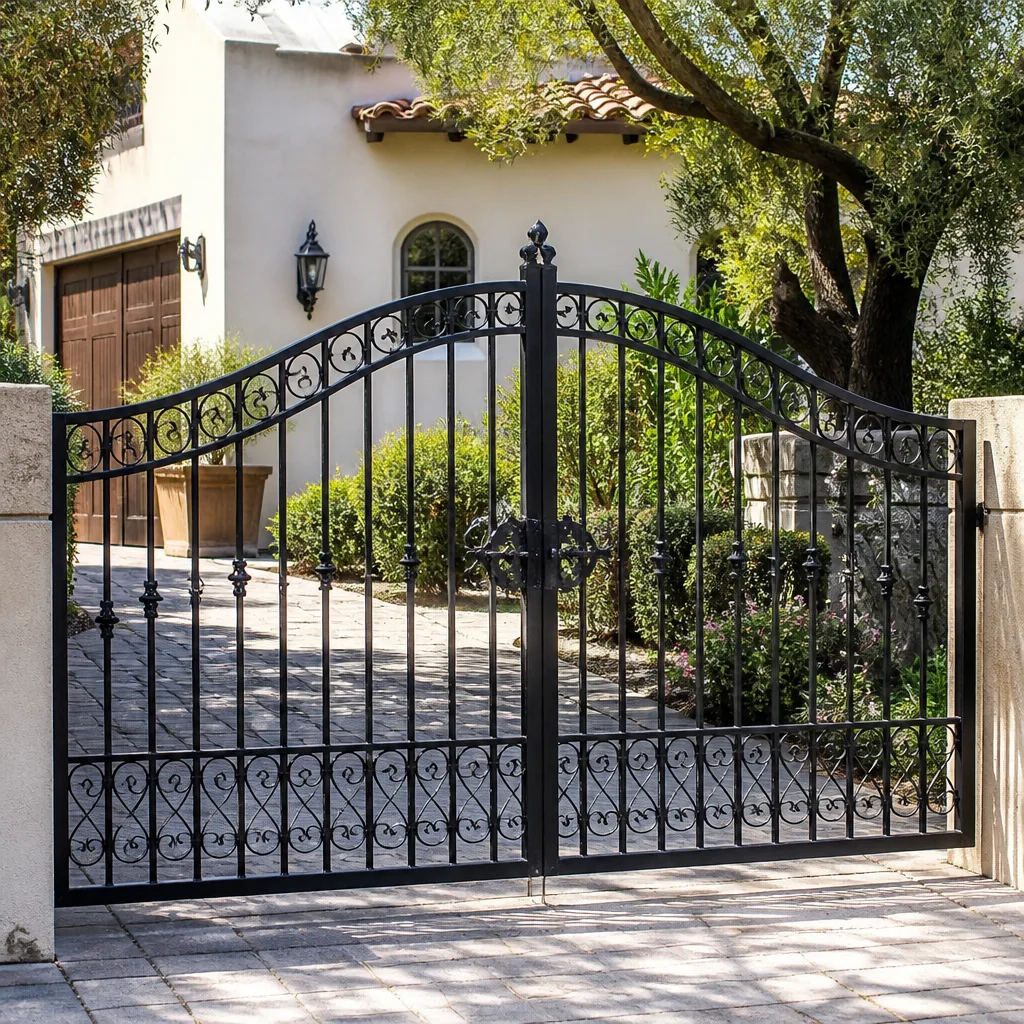 Wrought iron
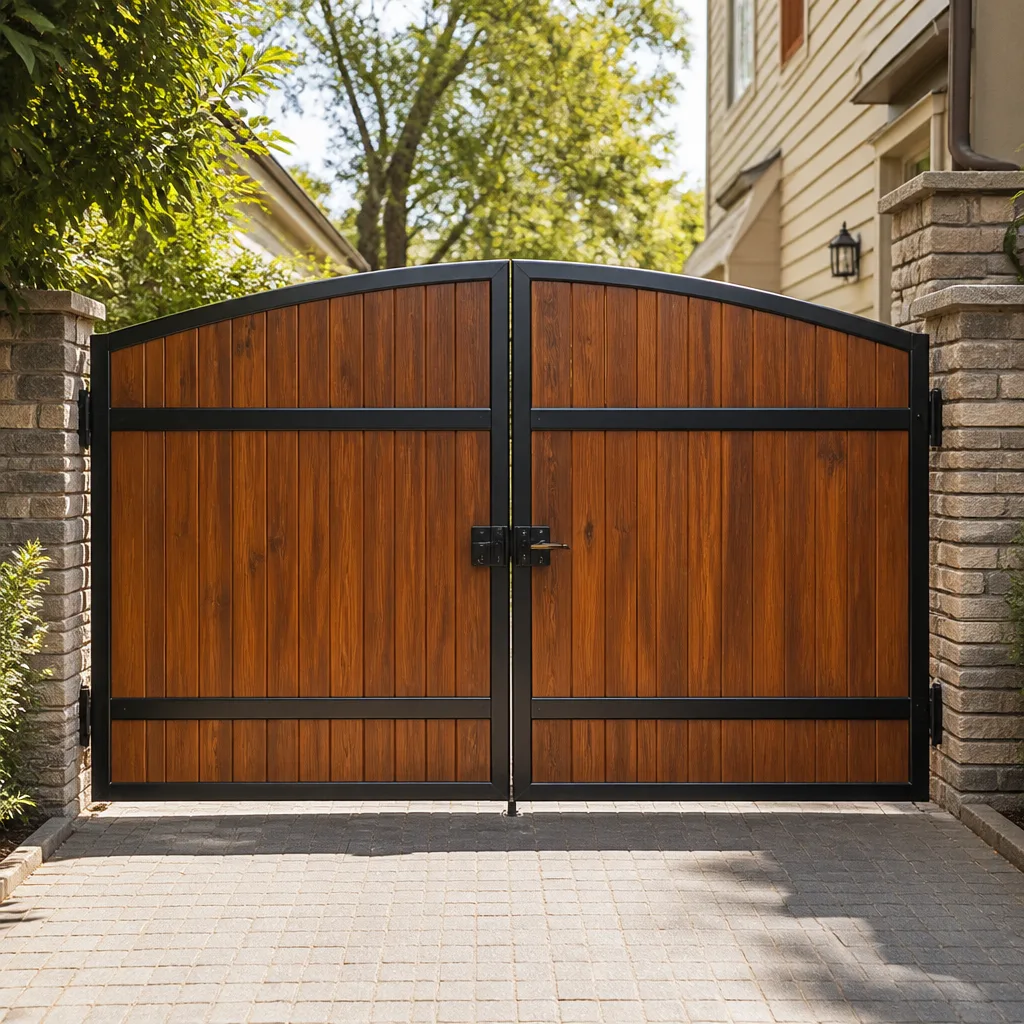 Wood & steel frame
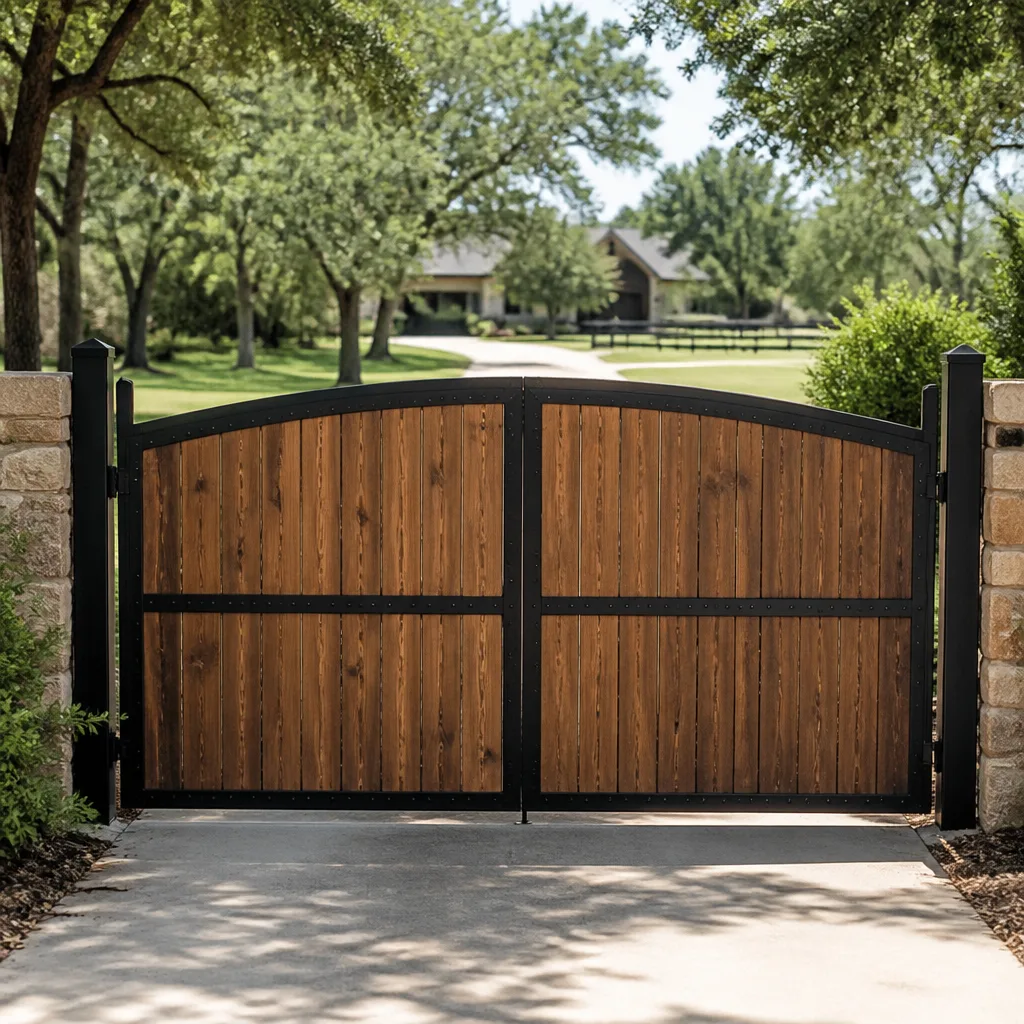 Farm & ranch
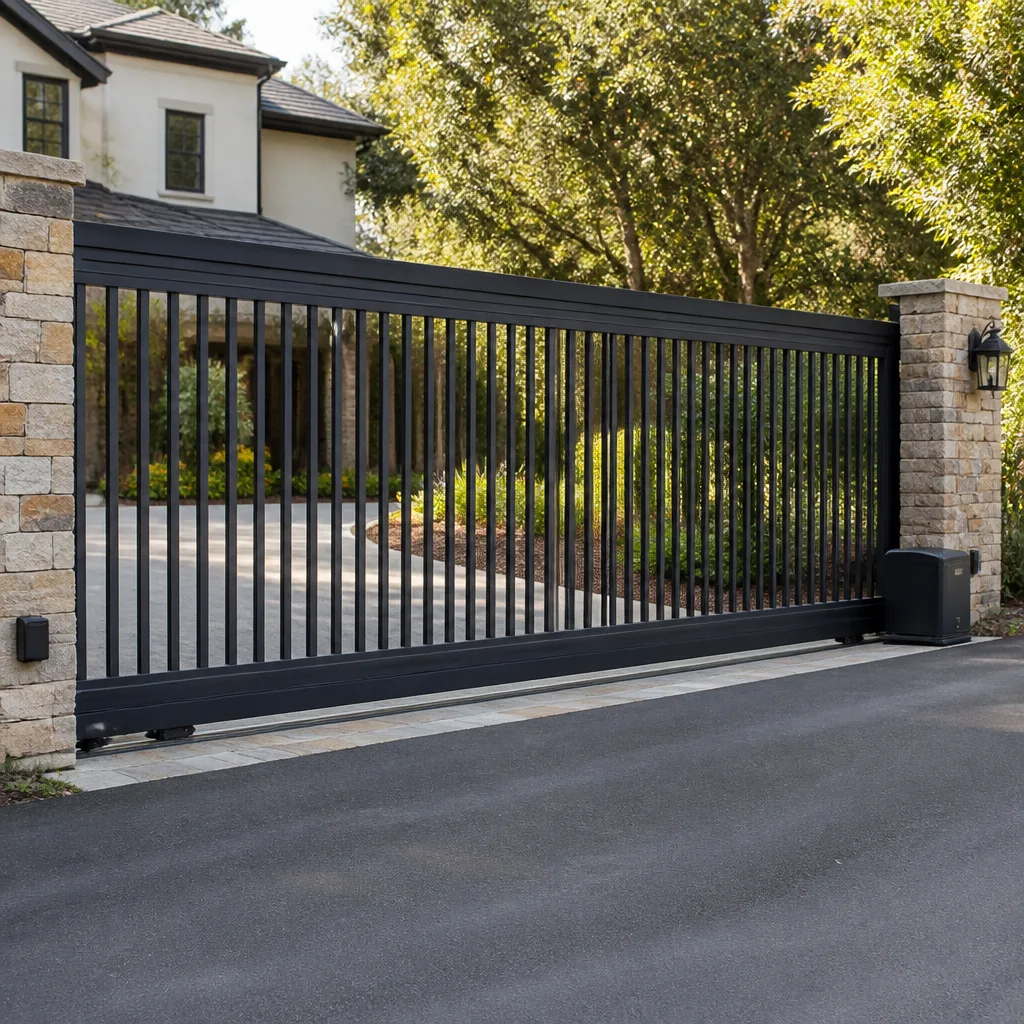 Sliding driveway gates
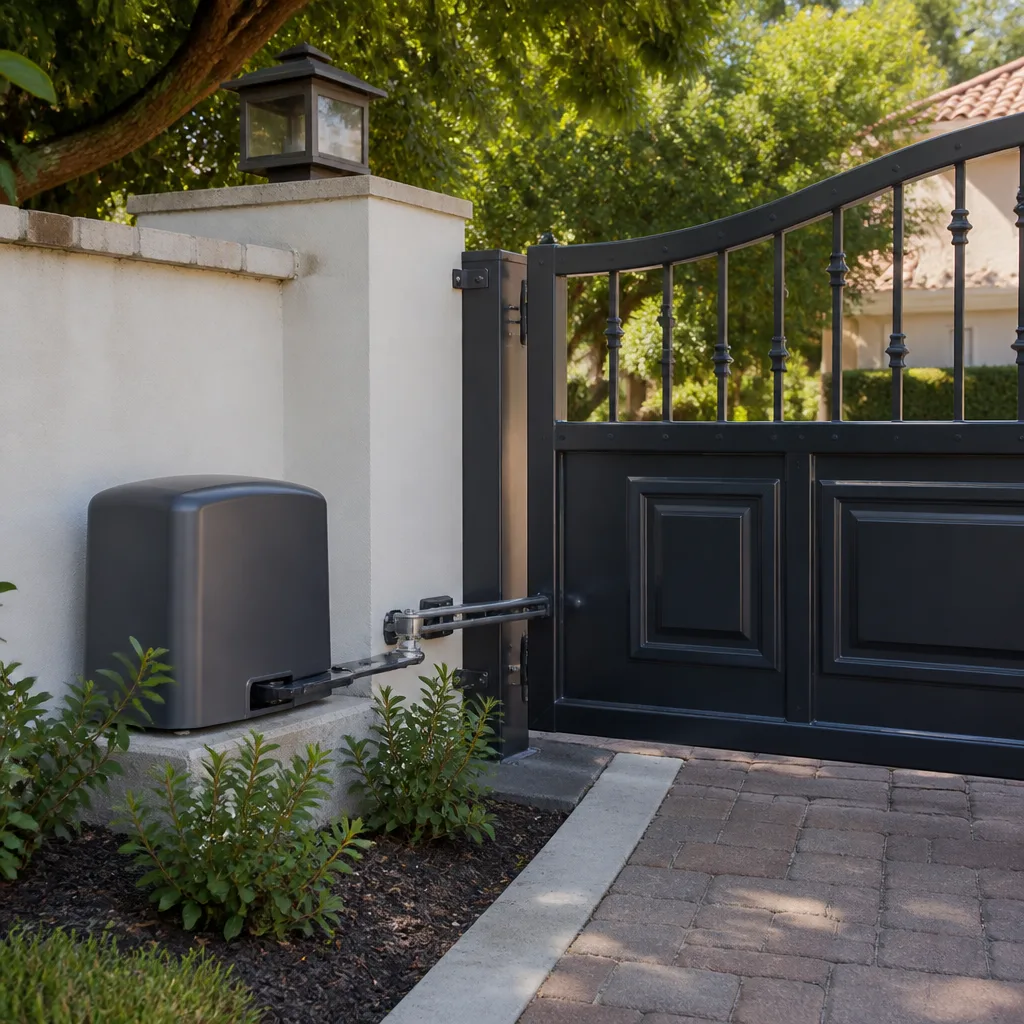 LiftMaster operators
Free on-site gate assessment - hinges, posts, and your LiftMaster or Nice gate operator checked before anything is quoted
The assessment is free and the quote is the invoice.
Get your free estimateDIY vs Professional Gate Repair: The West Palm Beach Homeowner’s Decision Guide
Adjusting the limit switches on a residential gate operator takes about eight minutes and requires no tools beyond a flat-head screwdriver. It is also one of the most common billable service calls in the gate industry. That single fact captures the asymmetry at the heart of this guide: some gate repairs are genuinely homeowner-appropriate, while others look equally simple but carry warranty, safety, and liability consequences that no instructional video mentions. This guide walks through the dividing line task by task, with West Palm Beach-specific code requirements, Florida humidity considerations, and the real math on what a failed DIY attempt actually costs. For a detailed look at expected expenses, see our Gate Repair Cost Breakdown: The West Palm Beach Homeowner’s Reference for 2026.
Quick Answer
Homeowners in West Palm Beach can safely handle limit switch adjustments, remote programming, battery backup replacement, and photo-eye sensor cleaning on their own gate systems. Control board replacement, structural hinge repair, buried loop detector work, and motor or operator replacement should be left to a licensed professional offering Gate Repair services, both for manufacturer warranty compliance and for liability protection under Florida building code.
Styles & brands we work with
Table of Contents
- The Real Divide: Not Skill, It’s Liability
- Safe DIY Tasks: What You Can Handle This Weekend
- Professional-Only Work: What Requires a Technician
- Florida Code and Liability: What West Palm Beach Homeowners Face
- Warranty Language: What DIY Work Voids
- The Real Cost of a Failed DIY Repair
- Three Questions to Ask Before Starting Any Gate Repair
- West Palm Beach-Specific Considerations
The Real Divide: Not Skill, It’s Liability
The DIY-versus-professional question for gate repair is not really about whether you can turn a wrench. It is about where liability sits when something goes wrong, and which repairs void manufacturer warranties the moment a non-authorized person opens the control box. Most automatic gate operators in West Palm Beach are installed under permits that carry specific inspection and service requirements. When a homeowner bypasses those requirements with an unpermitted modification, the liability for any resulting injury or property damage shifts squarely onto the homeowner.
We have seen this play out across West Palm Beach neighborhoods, from the gated communities off Flagler Drive to the older estates in Flamingo Park. A homeowner replaces a swing operator himself, skips the safety-edge calibration, and six months later the gate closes on a delivery truck. The operator manufacturer denies the warranty claim because the installation was not documented by an authorized service provider. The homeowner’s insurance then questions whether the gate was maintained to code. That is a $3,000 repair that became a $12,000 liability problem.
The honest dividing line looks like this: tasks that involve adjusting, programming, or replacing consumable parts are generally safe for a careful homeowner. Tasks that involve structural components, buried wiring, control board logic, or anything that changes how the gate interacts with the public right-of-way belong with a licensed technician. This is not gatekeeping. It is the difference between maintaining a system and modifying one.
Safe DIY Tasks: What You Can Handle This Weekend
Several gate repairs fall comfortably within homeowner capability, provided you have the owner’s manual and a little patience. These tasks share three characteristics: they are documented by the manufacturer, they do not require removing or rewiring the control board, and they do not affect the gate’s safety systems. Our technicians train on nine major gate motor brands, including FAAC, BFT, and Linear, and we can confirm that these five tasks are consistently homeowner-serviceable across all of them. For routine care tips, see our Gate Repair Maintenance Checklist for West Palm Beach Homeowners.
1. Limit Switch Adjustment
Limit switches tell the operator where the gate should stop in both the open and closed positions. When they drift, the gate may stop short, over-travel, or reverse unexpectedly. On most residential swing and slide operators, the limit switches are accessible behind a small access panel, identified in the manual, and adjustable with a flat-head screwdriver. This is the eight-minute job referenced at the top of this guide. If the gate stops at the wrong position, adjust the appropriate limit screw a quarter turn at a time, test the cycle, and repeat until correct.
2. Remote and Keypad Programming
Replacing a lost remote or reprogramming a keypad code does not require opening the operator housing. Most operators have a “learn” button on the control board or an external programming button. The owner’s manual includes the exact sequence. This task carries no structural risk and no warranty implications, since you are not altering the operator’s internal settings beyond what the manufacturer explicitly supports. If a new remote will not pair, the issue may be an antenna or receiver fault, which is a professional repair.
3. Battery Backup Replacement
Many West Palm Beach gate operators include a battery backup system so the gate functions during power outages, a meaningful feature during hurricane season. Battery backups are consumable parts, typically with a 2 to 4 year service life. Replacement involves unplugging the old battery, connecting the new one, and running a test cycle. The owner’s manual specifies the exact battery type. No programming is required. This is one of the few tasks where doing it yourself genuinely saves you money without increasing risk.
4. Photo-Eye Sensor Cleaning and Alignment
Photo-eye sensors, also called safety beams, sit low on the gate posts and collect dirt, grass clippings, and salt film in coastal air near West Palm Beach. When the beam is obstructed or misaligned, the gate refuses to close, which is a safety feature working correctly. Cleaning the lens with a soft cloth and realigning the sensors until the indicator light turns steady is a five-minute homeowner task. If the sensors are clean, aligned, and still not communicating, the problem is likely in the wiring or the sensor itself, which crosses into professional territory.
5. Track Cleaning and Debris Removal
Slide gates run on a track that accumulates sand, leaves, and debris. In West Palm Beach, where oak leaves and wind-driven sand are a constant, a slide gate that struggles or grinds often has a dirty track. Clearing the track with a stiff brush and checking for obstructions is routine maintenance any homeowner can do. What you should not do is adjust the track’s level or alignment. That requires a technician with a level and the experience to set the gate’s travel path correctly.
Professional-Only Work: What Requires a Technician
The tasks below share one trait: they involve either the gate’s safety-critical systems or its structural integrity. Florida building code draws a bright line here, and for good reason. An automatic gate is a moving vehicle barrier, and when it fails, it fails with force. Homeowners in West Palm Beach should treat these items as non-negotiable professional work.
Control Board Replacement
The control board is the brain of the gate operator. Replacing one involves more than swapping a circuit board, it requires matching the board to the operator model, configuring DIP switches and jumpers for the specific gate configuration, and reconnecting low-voltage wiring for safety edges, photo-eyes, and loop detectors. A miswired control board can disable safety features without any visible sign of a problem. On BFT and Viking operators, the control board settings also govern torque sensitivity, which is the difference between a gate that stops on contact and one that pushes through an obstacle. We have corrected DIY control board replacements where the safety inputs were bypassed entirely, leaving a gate that would close on a child or pet without reversing.
Structural Hinge and Post Repair
Wrought iron gates in West Palm Beach weigh hundreds of pounds, and they hang on hinges that take the full load every cycle. When a hinge wears, the gate begins to sag, which puts lateral stress on the post, which eventually breaks the post’s footing. Replacing a hinge or resetting a post is not a hardware-store job. It requires understanding how the gate’s weight is distributed, what the post anchor depth should be for the soil type in this part of Florida (sandy, high water table), and how to rehang the gate so it does not bind at the latch. A gate that falls because a homeowner replaced a hinge with the wrong grade bolt is a serious injury waiting to happen.
Buried Loop Detector Repair
Loop detectors are loops of wire buried in the driveway that sense when a vehicle is present and hold the gate open. When a loop fails, the gate may not open for approaching cars or may close on one that is still in the path. Loop detector repair involves locating the break with specialized equipment, excavating the driveway surface, splicing the wire, and sealing the repair so moisture does not re-enter. This is not a DIY task under any reasonable definition. It is also one of the most misdiagnosed failures, because the symptom (gate won’t open) looks similar to a remote problem or a control board fault. A technician can isolate the loop as the source before digging, which prevents unnecessary damage to the driveway surface.
Operator and Motor Replacement
Replacing an entire gate operator is the highest-consequence repair on this list. It involves disconnecting the old unit from the gate and the power supply, mounting the new operator, setting the torque and limit parameters, connecting all safety inputs, and testing under load. Then comes the part most DIY videos skip: documenting the installation for warranty purposes. Most operator manufacturers, including FAAC and Linear, require installation by a qualified technician for the warranty to take effect. A homeowner-installed operator that fails in month three is a $1,200 to $2,400 paperweight with no warranty coverage. Our gate installation in West Palm Beach service includes full documentation for every operator we install.
Safety Edge and Entrapment Sensor Replacement
Safety edges are the pressure-sensitive strips on the leading edge of the gate that reverse it on contact. They are the last physical line of defense against entrapment, and they must be calibrated to the specific operator and gate weight. Replacing one involves running low-voltage wiring through the gate frame, which on a wrought iron gate means fishing wire through tight channels without nicking the insulation. A nicked wire that shorts intermittently will disable the safety edge without triggering any visible error. UL 325, the standard governing automatic gate safety, treats this as professional work. Florida code references UL 325 directly.
Florida Code and Liability: What West Palm Beach Homeowners Face
Florida is one of the few states that specifically addresses automatic gate safety in state building code. The Florida Building Code incorporates UL 325 by reference, which establishes performance requirements for gate operators, safety devices, and entrapment protection. What this means in plain English: an automatic gate in West Palm Beach is not just a convenience, it is a regulated device with specific safety obligations attached to it.
The code is clear that automatic gate operators must be installed and maintained to meet UL 325 entrapment protection requirements. Those requirements include two independent means of entrapment protection, typically a primary device like an inherent entrapment sensor (built into the operator) and a secondary device like a photo-eye or safety edge. When a homeowner modifies the gate system, whether by adjusting the operator’s internal settings or rewiring a safety device, the homeowner takes on responsibility for maintaining that compliance. If a gate modified by an unlicensed individual injures someone, the homeowner’s liability exposure is substantially higher than if a licensed contractor had performed the work and documented the gate’s compliance.
West Palm Beach also sits in a hurricane-prone region, which adds a layer of code obligation around wind-load ratings for gate structures. A gate that is modified structurally, say by replacing hinges or extending the gate’s height, may no longer meet its original wind-load specification. That is a permitting issue, not just a repair issue.
The practical takeaway: the questions to ask yourself about DIY work are not just “Can I do this?” but “If this gate hurts someone after I work on it, what is my exposure?” A licensed gate contractor in Florida carries liability insurance and is bound by code. A homeowner doing unlicensed work is personally exposed.
Warranty Language: What DIY Work Voids
Most homeowners do not read their gate operator warranty until they need it, and by then it is often too late. The warranty language across major brands follows a consistent pattern, and understanding it before you start a repair can save you thousands.
Typical language in operator warranties from brands like FAAC, BFT, Linear, and Viking includes clauses stating that the warranty covers defects in materials and workmanship under “normal use and service” and specifically excludes damage caused by “unauthorized modifications, adjustments, or repairs.” The word “unauthorized” is doing the heavy lifting. It means work not performed by a qualified technician following the manufacturer’s installation and service documentation. When a homeowner opens the control box and changes wiring, settings, or components, the manufacturer’s position is that the equipment has been altered, and warranty claims will be denied for any related failure.
The warranty language also frequently requires that installation be performed by a “qualified installer” or “authorized service provider,” and that proof of that installation be retained. This is the documentation gap referenced earlier in this guide. A homeowner who buys a new operator, installs it over a weekend, and then files a warranty claim when the board fails two months later has no documentation to present. The claim is denied, and the homeowner eats the replacement cost.
There is a second layer: some warranties cover parts only, not labor, but require that the failed part be diagnosed by an authorized service provider before the warranty replacement is issued. That means even if the part is defective, the homeowner must pay a technician to diagnose the failure before the manufacturer will ship a replacement. If the homeowner has already opened the unit and tampered with the wiring, the diagnosis gets more complicated and the claim gets slower.
The bottom line on warranty: routine homeowner maintenance like battery replacement, sensor cleaning, and remote programming does not void coverage. Opening the control board, modifying wiring, replacing the operator yourself, or bypassing any safety device very likely does. When in doubt, check the “What This Warranty Does Not Cover” section of your manual before picking up a screwdriver.
The Real Cost of a Failed DIY Repair
The economics of DIY look different on the front end than they do on the back end. The front-end math is simple: a $75 service call fee versus free. The back-end math is where homeowners get hurt, and it is worth laying out line by line.
Consider the most common failed DIY scenario we see across West Palm Beach: a homeowner replaces a swing gate operator themselves, the gate does not work correctly, and then a technician is called in. The homeowner has already spent $800 to $1,500 on the operator. The technician arrives to find the operator installed incorrectly, safety inputs unwired, and in some cases the control board already damaged by incorrect line-voltage wiring. The technician’s job is now more complex than a standard installation, because the work must be diagnosed, de-installed, inspected, and redone correctly. This typically adds $200 to $400 in labor compared to a clean installation, which is the premium contractors charge to correct work that was started incorrectly.
The secondary damage risk is the bigger number. A gate operator installed without proper torque limits can overload and damage the gate’s hinge structure. That $300 hinge repair becomes a $900 post-resetting job. A loop detector wired incorrectly can short out the new control board. A DIY control board replacement that misconnects the transformer can send line voltage through low-voltage components, destroying the board and possibly the receiver module.
The framework for thinking about this: estimate the parts cost of the DIY attempt, then add the cost of a professional to diagnose and correct any mistakes, then add the cost of any secondary damage to the gate structure that occurred because the system operated incorrectly. In our experience, a failed DIY operator replacement in West Palm Beach ends up costing 20% to 40% more than having the work done professionally the first time. And that is before accounting for the warranty being voided and the liability exposure under Florida code.
Three Questions to Ask Before Starting Any Gate Repair
Before you pick up a screwdriver or order any parts, there are three questions that will tell you more than any YouTube video. For more guides & resources, explore our blog. These questions cut through the noise and get you to the right decision in under five minutes.
Question 1: Can I find the part using the model number?
If you cannot identify the exact model number of your gate operator and the exact part number you need, stop. Ordering a part that looks right in a photo but has the wrong voltage rating, the wrong shaft size, or the wrong communication protocol is the single most common cause of failed DIY repairs. On Linear and FAAC operators especially, parts are not interchangeable across model lines. The model number is on a label on the operator housing. If you cannot read it, take a photo and zoom in. If you cannot find a part number from that model number, it is time to call a technician.
Question 2: Does this work appear in the owner’s manual?
Every gate operator ships with an owner’s manual, and every manual has a section on homeowner maintenance. If the repair you are planning appears in that section, like battery replacement, remote programming, or sensor cleaning, it is fair game for a careful homeowner. If the work is not in the homeowner section, that is the manufacturer telling you that this task is beyond routine owner maintenance. Tension springs on a wrought iron gate do not appear in any homeowner manual, for example. That is professional work, and attempting it with a pry bar is how people get seriously hurt.
Question 3: Does my warranty require professional installation or service?
Pull up your operator’s warranty document and read the exclusions. Look for the words “unauthorized,” “qualified,” “authorized service provider,” or “improper installation.” If those words appear and your repair falls outside routine maintenance, doing the work yourself voids your coverage. The calculation here is straightforward: whatever you save on labor, you are betting against the warranty value. On a two-year-old operator with a five-year parts warranty, that bet is usually a bad one.
If you can answer yes to all three questions and the work is in the homeowner maintenance section of your manual, proceed carefully. If you answer no to any of them, the math points to a professional. In West Palm Beach, a professional means someone licensed, insured, and documented, which is the standard we hold at Carver Gate Repair West Palm Beach home.
West Palm Beach-Specific Considerations
Gate systems in West Palm Beach live a harder life than their counterparts in drier, cooler parts of the country, and that reality should inform every DIY decision. The coastal humidity accelerates corrosion on control boards and wiring connections. The afternoon thunderstorms, common from June through October, expose every weak point in a gate’s weatherproofing. The sandy soil shifts, which affects post stability and loop detector performance. A gate repair that is purely cosmetic in Phoenix is a structural issue in West Palm Beach.
We see the effects in specific ways. Control boards in coastal neighborhoods like El Cid and Southland Park fail more frequently due to salt air corrosion on circuit traces. Slide gates in communities near the Intracoastal bind more often because the track supports shift as the sandy soil settles seasonally. Loop detectors in older neighborhoods with mature root systems fail when tree roots grow into the loop trench and sever the wire. These are not abstract concerns; they are the specific repair patterns that define gate work in this market.
There is also the storm-season factor. From June through November, West Palm Beach homeowners need their gates functional because a non-operating gate can be a code and insurance issue during an evacuation or post-storm recovery, not just an inconvenience. A DIY repair attempted in April that fails quietly in August becomes a problem at exactly the wrong time. Battery backups, in particular, should be tested and replaced before hurricane season, not during it.
For homeowners who decide the professional route is the right call, gate repair in West Palm Beach through our shop includes a written price before any work starts. That is important in this market, where the cost of service varies widely and the instinct to negotiate at the door is strong. We do not negotiate at the door because we do not need to: the price is on paper, agreed before the technician opens a panel.
Common Mistakes to Avoid
- Replacing an operator without checking warranty requirements. This single mistake voids the manufacturer’s warranty and leaves you holding the full replacement cost if the unit fails. Always read the warranty exclusions before purchasing any operator, not after the install.
- Assuming all gate problems are electrical. In West Palm Beach, many gate failures are mechanical: sagging hinges, shifting posts, debris in the track. Replacing a control board when the gate is binding at the hinge wastes the board and leaves the real problem untouched.
- Bypassing a safety device to get the gate working. Jumping out a photo-eye or safety edge because you want the gate to close is the most dangerous thing a homeowner can do, and it voids the system’s UL 325 compliance. This creates personal liability exposure that is difficult to understate.
- Ordering parts by appearance instead of part number. Two gate opener arms can look identical and have completely different voltage requirements, stroke lengths, and mounting brackets. The part number on your existing unit is the only reliable way to order a replacement.
- Waiting until hurricane season to address known gate problems. Every technician in West Palm Beach is fully booked in the weeks before a storm. If your gate is grinding, sagging, or intermittent in March, fix it in March.
- Working on tension springs without the proper tooling. Gate tension springs store enormous kinetic energy. A homeowner in Palm Beach Lakes was hospitalized last year when a spring he was adjusting with a screwdriver released into his face. This is not a repair task; it is a medical risk.
- Resetting a sagging gate by tightening hinge bolts. Sagging is usually caused by worn hinge pins or a failing post, not loose bolts. Overtightening the bolts strips the threads and makes the eventual professional repair more expensive.
See the difference
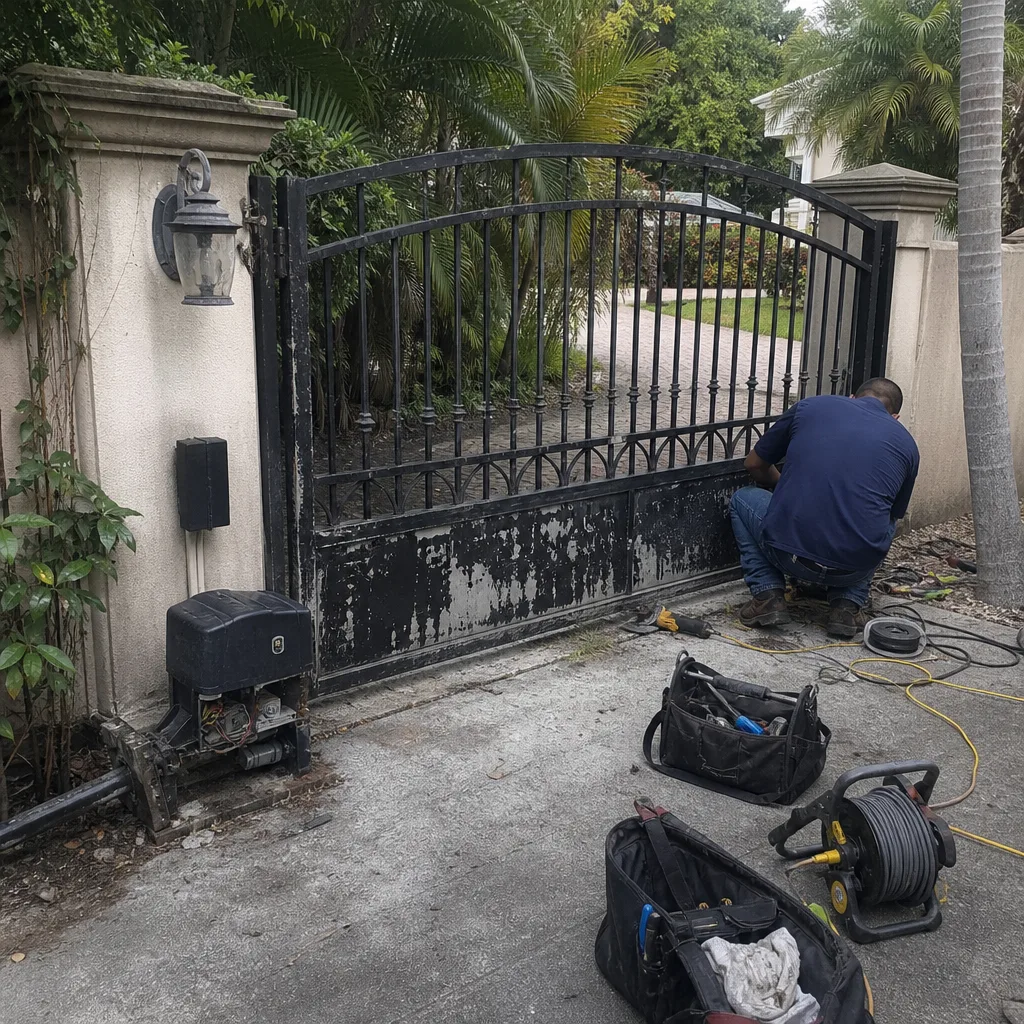 Before
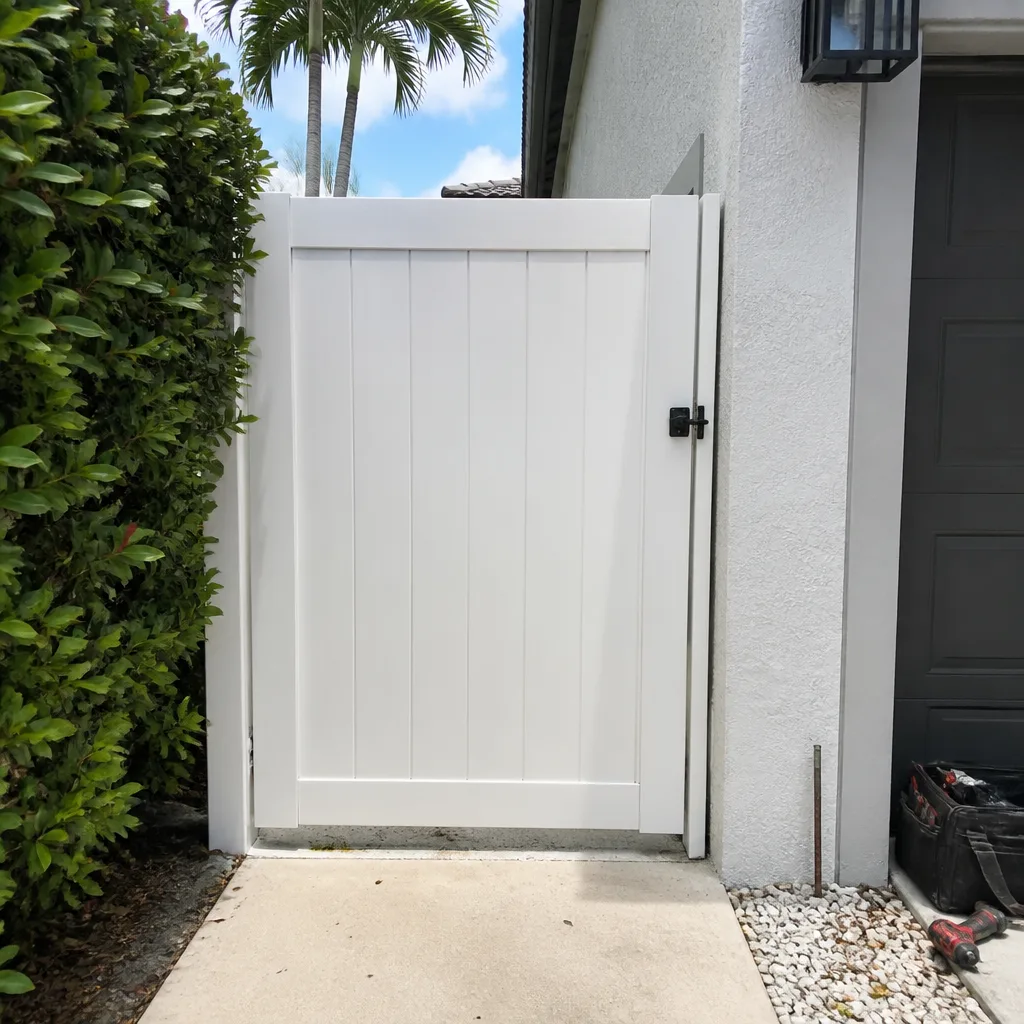 After
After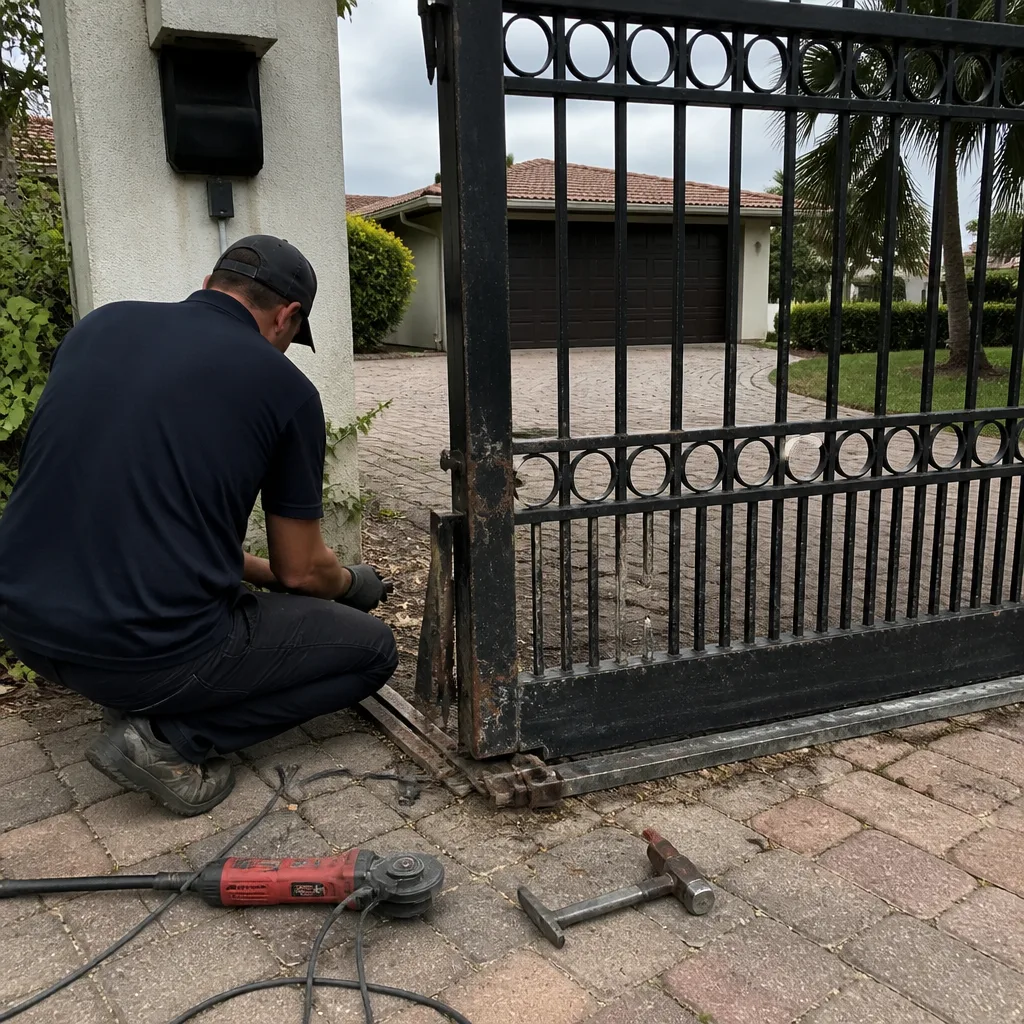 Before
 After
After Before
 After
AfterWhen to Call a Professional
The line is simple: call a professional when the repair involves the control board, the gate structure, the safety systems, the buried loop detector, or anything that changes how the gate interacts with vehicles and pedestrians. Call a professional when the gate is needed for security and cannot be left inoperable while you troubleshoot. Call a professional when you cannot identify the part by model number, or when your warranty language requires authorized service. And call a professional when you have already attempted a repair and the gate is now behaving worse than before; correcting botched work is faster and less expensive when it is caught early. Gate motor repair in West Palm Beach through Carver Gate Repair West Palm Beach includes a free estimate, and we answer the phone around the clock at (728) 203-2413.
Frequently Asked Questions
Gate repair in West Palm Beach typically runs between $150 and $450 for common issues like limit switch adjustments, sensor replacement, and remote programming, with control board replacement running $400 to $900 and full operator replacement running $1,200 to $2,400 including labor. Motor replacement on a swing gate commonly lands between $1,000 and $2,000, while structural hinge work on a wrought iron gate ranges from $300 to $900 depending on the post condition. Every job we quote includes a written price before any work starts, so the number you approve is the number you pay. Call (728) 203-2413 for an exact quote on your specific gate.
For most common repairs like limit switches, remote programming, sensor faults, and battery battery replacements, same-day service is available throughout West Palm Beach including neighborhoods like El Cid, Flamingo Park, and Southland Park. Structural repairs and operator replacements may require ordering parts or scheduling a longer service window, but our technicians are dispatched with common components for FAAC, BFT, Viking, and Linear systems already on the truck. Call (728) 203-2413 to check current availability.
No, limit switch adjustment is a documented homeowner maintenance task on nearly all residential gate operators, including those from FAAC, BFT, and Linear, and it does not void the manufacturer’s warranty. The manual describes the procedure and the adjustment points. However, opening the control board housing and changing internal wiring or DIP switch settings is a different matter and may void coverage if it constitutes an “unauthorized modification.” When in doubt, check the exclusions section of your warranty document.
Replacing an existing gate operator with a like-for-like unit generally does not require a permit in West Palm Beach, but any structural modification to the gate itself or any change to the electrical supply may trigger permit requirements under Florida Building Code and city of West Palm Beach regulations. New gate installations, particularly those with automatic operators, typically do require permitting. A licensed gate contractor can confirm the permitting requirements for your specific project before work begins.
Our technicians train on nine major gate motor brands, including FAAC, BFT, Linear, Viking, LiftMaster, Ghost Controls, DoorKing, Elite, and Mighty Mule. That matters because the control board settings, limit switch locations, and programming sequences differ meaningfully between brands, and a technician who only knows one or two systems will take longer and make more mistakes on the rest. Matching the technician to the equipment already installed is the fastest path to a correct repair.
A quality residential gate operator in West Palm Beach typically lasts 8 to 12 years with proper maintenance, though coastal salt air and humidity can shorten that to 6 to 10 years for systems within a mile of the Intracoastal or the ocean. The most common cause of premature failure is moisture intrusion at the control board, followed by lack of lubrication on the mechanical drive components. Annual inspection and maintenance, including checking seals and lubricating moving parts, is the most effective way to extend operator life in this climate.
The Bottom Line
The DIY-versus-professional question is not about pride or capability. It is about liability, warranty, and the specific failure patterns of gate systems in West Palm Beach’s heat, humidity, and hurricane seasons. Homeowner-appropriate tasks are clearly documented in your operator’s manual and involve batteries, remotes, sensors, and simple adjustments. Everything beyond that belongs with a licensed technician who carries insurance, documents the work for warranty purposes, and leaves the gate compliant with Florida code. Carver Gate Repair West Palm Beach provides written prices before work starts, written guarantees on every repair for a full year, and background-checked, uniformed technicians on every call. If you are unsure which category your repair falls into, call (728) 203-2413 and ask. We will tell you straight, even if the answer is “you can do this one yourself.”
Written by Lonnie Burke, Owner at Carver Gate Repair West Palm Beach, serving West Palm Beach since 2008.