
Last updated October 16, 2026
 Wrought iron
 Wood & steel frame
 Farm & ranch
 Sliding driveway gates
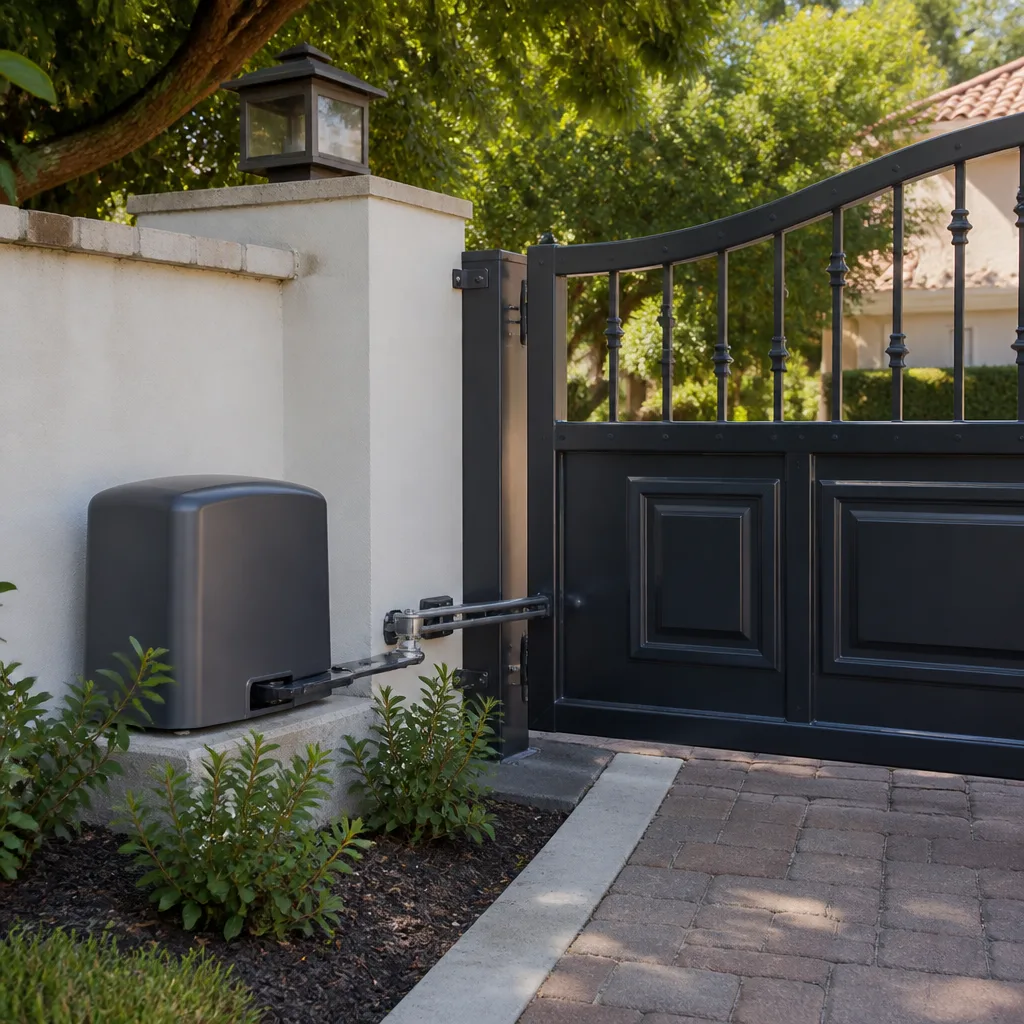 LiftMaster operators
Free on-site gate assessment - hinges, posts, and your LiftMaster or Nice gate operator checked before anything is quoted
The assessment is free and the quote is the invoice.
Get your free estimateGate Repair Warning Signs: A West Palm Beach Homeowner’s Reference Guide
Most gate failures in West Palm Beach don’t happen without warning. They announce themselves weeks or months ahead of time through small behavioral changes that get dismissed as quirks. A gate that reverses for no apparent reason is almost never a sensor malfunction; it’s usually mechanical resistance that the operator’s safety logic is detecting correctly. Replacing the sensors, which is the most common first response, fixes nothing and delays the real diagnosis by weeks. This guide teaches you to read the actual signal, not the surface symptom, so you know what you’re looking at before you pick up the phone.
Styles & brands we work with
Quick Answer
The most common gate repair warning signs in West Palm Beach are slow movement, partial reversal, grinding or clicking during travel, failure to latch or close completely, reduced remote range, and erratic cycling. Most of these symptoms point to mechanical drag or failing capacitors rather than the motor itself. A slow gate usually means the operator is compensating for increased resistance, and that resistance is the real problem.
Table of Contents
- Reading the Signal, Not the Symptom
- The Twelve-Symptom Index: What You See vs. What’s Happening
- Electrical vs. Mechanical: How to Tell Them Apart Without Tools
- South Florida Warning Signs: Rust, Salt, and Rainy Season Swelling
- Monitor or Shut Down: Which Warning Signs Demand Immediate Action
- How to Document a Warning Sign So Your Phone Call Gets a Real Diagnosis
- What These Warning Signs Typically Cost to Fix in West Palm Beach
- Common Mistakes to Avoid
- When to Call a Professional
- Frequently Asked Questions
- The Bottom Line
Reading the Signal, Not the Symptom
A gate system is a chain of components: the operator motor, the drive mechanism (chain, belt, screw, or hydraulic arm), the wheels or hinges, the track or pivot points, and the control board that coordinates everything. When one component starts to fail, it rarely announces itself directly. Instead, it changes the behavior of the whole system, and that changed behavior is what you see.
Here’s the core insight this guide is built around. A slow gate is not a motor problem. The motor is a fixed-output device: it applies roughly the same force every time. When travel time doubles, the operator is encountering twice the resistance and working harder to move the gate. The resistance comes from somewhere else: worn wheels, a sagging hinge, a track clogged with sand, a warped frame after a wet season. In our experience across West Palm Beach, we regularly find that homeowners and even some technicians replace operators only to watch the new motor strain against the same drag. The gate was never the motor’s fault.
Understanding this distinction changes how you approach every warning sign in this guide. Before you replace anything, figure out what’s actually failing. The symptom points you there if you know how to read it.
For a broader look at what professional repair involves, see our Gate Repair in West Palm Beach page.
The Twelve-Symptom Index: What You See vs. What’s Happening
Here are twelve observable gate behaviors, where the real problem usually lives, and what to do about it. These are the warning signs we see most on service calls in West Palm Beach neighborhoods from El Cid to Ibis.
- Symptom: The gate moves noticeably slower than it did three months ago.
Likely cause: Mechanical drag. Worn wheels on a sliding gate, corroded hinge pins on a swing gate, or track buildup. The motor is compensating. What to do: Check for visible debris first, then call for a resistance assessment before the motor burns out. - Symptom: The gate starts, stops, then reverses before reaching the closed position.
Likely cause: The operator’s safety circuit is detecting resistance above its threshold. That’s not a sensor malfunction; the sensors are working correctly. The root cause is usually a failing capacitor that can’t provide enough torque at the end of travel, or a physical obstruction that has not been cleared. What to do: Don’t disable the safety. Find the resistance. - Symptom: A grinding noise during travel.
Likely cause: Metal-on-metal contact. On a sliding gate, it’s usually a derailed or collapsed guide roller. On a swing gate, it’s typically a hinge that has lost lubrication and is abrading its pin. What to do: Grinding means material is being removed. Shut the gate down and inspect or call immediately. - Symptom: A rhythmic clicking from the operator but no gate movement.
Likely cause: The drive gear or sprocket has stripped, or the chain has jumped. The motor is spinning, so it sounds like the gate should move, but the mechanical connection is gone. We see this frequently on DoorKing and Elite operators after years of pushing against rusted tracks. What to do: Stop cycling the gate. Continuing to run the motor with no load transfer will destroy it. - Symptom: The gate fails to latch or doesn’t fully close, leaving a gap of an inch or two.
Likely cause: The limit switch has drifted out of adjustment, or the latch assembly has shifted as the gate settled. What to do: A gate that doesn’t latch is a security problem. This is a straightforward adjustment, but it needs to be done correctly so the operator doesn’t fight itself. - Symptom: Remote range drops from across the street to right at the gate.
Likely cause: The receiver antenna has corroded, or the control board’s power supply is degrading and giving the receiver less to work with. In coastal West Palm Beach air, we see antenna corrosion constantly. What to do: A range drop is usually an inexpensive fix if caught early; let it go and the board can fail. - Symptom: The gate cycles open and closed on its own at random.
Likely cause: A failing loop detector picking up phantom signals, or a control board failing from moisture or voltage irregularity. What to do: Erratic cycling is a safety hazard: the gate can close on a vehicle or person. Disconnect the operator from power and call immediately. - Symptom: A humming from the operator but no movement at all.
Likely cause: A failed start capacitor. The motor can’t build enough torque to start rotation, so it sits and hums until the thermal overload trips. This is the most common repairable electrical failure we see. What to do: Don’t keep cycling. A capacitor replacement is quick and inexpensive relative to replacing the operator. - Symptom: The gate moves in jerks or pulses instead of a smooth stroke.
Likely cause: A failing gearbox or a scored drive screw. Motion is being interrupted by mechanical binding at a specific point in the travel. What to do: Note exactly where in the travel the jerking happens: that tells you where the damage is. - Symptom: A burning smell from the operator housing after use.
Likely cause: Overheating from excessive load, or failing internal insulation on the transformer or motor windings. What to do: Stop using the gate. A burning smell is never a warning sign to monitor; it’s one to shut down. - Symptom: The gate sags visibly at the free end (for a swing gate) or scrapes the ground (for a sliding gate).
Likely cause: Hinge wear or post settlement in sandy South Florida soil. What to do: Sagging gates transfer enormous force into the operator, which is built to move weight, not carry it. Address the mechanical sag before it destroys the motor. - Symptom: The gate stops mid-travel and the operator alarm sounds.
Likely cause: The entrapment protection is working, or the thermal overload is tripping. Either way, the cause is resistance. What to do: Don’t silence the alarm and reset without understanding why it tripped. Find the load.
Electrical vs. Mechanical: How to Tell Them Apart Without Tools
You don’t need a multimeter to make a useful first-level diagnosis. You need your eyes, your ears, and the flashlight on your phone. Here’s a simple three-step process we walk homeowners through on the phone every week in West Palm Beach.
Step 1: Watch where the hesitation happens. A mechanical problem is position-specific. If the gate bogs down at the same point every cycle, you’re looking at a physical obstruction or a worn component at that location: a bad wheel at the mid-track, a hinge that binds at forty-five degrees. An electrical problem is usually not position-specific. A failing capacitor affects the whole stroke. A degraded control board affects the whole cycle. Where the symptom appears tells you a lot.
Step 2: Listen to the motor while the gate is struggling. A motor that’s working correctly under mechanical load sounds like it’s working hard: pitch drops, maybe a strained note, but it’s driving. A motor with an electrical fault sounds different: clicking, buzzing without engagement, or whining without corresponding movement. If the sound and the motion don’t match, the disconnect is electrical. If the sound matches the labor of the motion, the load is the problem.
Step 3: Look for local marks of wear. Shine your phone flashlight along the track, around each hinge, at the bottom of the gate frame. Look for metal shavings (grinding), rust tracks (corrosion), rubber dust (wheel wear), or a polish line on the metal (repeated contact that shouldn’t be happening). These are physical evidence trails. Mechanical failures leave them. Electrical failures don’t.
One more tell, specific to our climate: if the gate behaves worse after rain or during humid weeks, the problem is almost always at a connection point or a control board absorbing moisture. Dry-season performance that drops in the wet season is an electrical signature. Mechanical problems respond more to temperature and load changes than to humidity.
If you’ve walked through these steps and you’re still unsure, that’s what the phone is for. Our website’s Carver Gate Repair West Palm Beach home page has the full service picture, but you can also just describe what you see and hear; a good technician can narrow it down from your description.
South Florida Warning Signs: Rust, Salt, and Rainy Season Swelling
West Palm Beach throws three specific challenges at gate systems that you won’t find in most of the country. They create warning signs that look unlike anything in a generic repair manual.
Rust staining at the pivot points and wheels. If you see a rust-colored drip mark running down from a hinge or a wheel bracket, water is sitting in that joint and pushing corrosion deep into the bearing surface. A surface rust smudge is cosmetic; a drip stain means active internal corrosion. We see this most often on ocean-side properties and neighborhoods within a few miles of the Intracoastal, where salt air accelerates the process year-round. The stain is an early warning. By the time the hinge squeals or the wheel stops spinning, the component is often beyond saving.
Salt-white residue on the control board. Open the operator housing once a season and look at the circuit board. If you see a chalky white film on any component or solder joint, that’s salt deposition from the air. It’s conductive, and it slowly shorts the board. This is the West Palm Beach version of a time bomb. The board may function normally right up until it doesn’t. If you spot this and the gate still works, you’ve caught a failure before it happened, which immeasurably cheaper than catching it after.
Swelling at wood gate frames after the rainy season. If your gate is wood, watch what happens in September and October, after months of daily downpours. Wood gates absorb water, swell, and then don’t always return to their original dimensions when they dry. The gate hangs heavier, the hinges shift, and the operator starts working against a frame that has subtly changed shape. Telltale signs: paint cracking at the joints, a gate that drags on the latch side after a wet week, or visible gaps opening at glued seams. This is a mechanical problem feeding into the electrical system; the motor didn’t fail, it got assigned extra work.
If you’re seeing rust stains, salt residue, or swelling and want to know what it means for your system specifically, our Gate Motor Repair in West Palm Beach page explains what a motor assessment covers.
Monitor or Shut Down: Which Warning Signs Demand Immediate Action
Not every warning sign requires an emergency call. Some can be watched for a week or two while you schedule service at your convenience. Others need the gate disconnected immediately. Here’s the difference.
Monitor and schedule service applies to symptoms that are progressive but not immediately dangerous: a gate that moves slightly slower than it used to, a first-time range drop on the remote, a small rust stain that hasn’t progressed, a slight gate sag that’s been the same for months. None of these will damage anything in the next seven days if the gate continues normal use. They will get worse over time, and they will cost more the longer you wait, but they don’t require shutting down tonight.
Immediate shutdown applies to symptoms that create or indicate a safety risk:
- A gate that reverses unpredictably during the closing stroke. This means the entrapment protection is repeatedly triggering, which means something is generating enough resistance to fool the system into thinking a person or car is in the way. The safety logic is working, but the mechanical load behind it is not normal. A gate that closes on a car, a child, or a pet is a catastrophic failure, not an inconvenience.
- Erratic cycling. A gate that opens and closes on its own can strike anyone near it. Disconnect power and call for diagnosis before using it again.
- A burning smell. Overheating components can smoke and ignite, and the smell indicates the insulation is already failing. Do not run the gate again until the source is found.
- Any sound of metal grinding while moving. Material is being removed from the system on every stroke. Every cycle makes the repair more expensive and the failure more likely to happen with the gate mid-travel.
- A sagging gate that drags the ground or visibly drops when you release the manual override. This is a structural failure in progress, and the operator is now load-bearing. The motor will fail next, and it may fail while the gate is in motion.
In short: if it makes a noise, moves erratically, smells, or reverses without explanation, stop using it. If it’s just slower or slightly less reliable, you have a short window to schedule the visit.
If you’re seeing a dangerous symptom at a gate you still need to use, see our Gate Repair in West Palm Beach page for next steps.
How to Document a Warning Sign So Your Phone Call Gets a Real Diagnosis
Here’s how to describe what you’re seeing in a way that lets a technician identify the likely fault before they arrive. This is the difference between a phone call that ends with “we’ll come out and take a look” and one that ends with “that sounds like a limit switch; we’ll bring the part.”
Step 1: Note the time and conditions of the failure. Write down the date, the time of day, the approximate temperature, and the weather. Did it happen during a downpour, during a dry afternoon, at 6 a.m. when the air was cool and damp? West Palm Beach humidity patterns are diagnostically useful: moisture-related faults appear in the early morning and after rain, while load-related faults show up in the afternoon heat when metal has expanded.
Step 2: Capture the exact behavior, not your interpretation. Say “the gate starts, moves about two feet, then reverses to open” instead of “the sensor’s tripping.” Say “the remote works from the driveway but not from the street” instead of “the battery’s dead.” The technician will interpret the behavior; your job is to report it accurately. If you can, record a ten-second video on your phone. A video of the symptom in progress is worth more than any verbal description.
Step 3: Locate the problem in the gate’s travel, to the foot. If the gate bogs down, reverses, or makes noise, note exactly where in the opening or closing stroke it happens. “About two-thirds closed, and it grinds for a second, then continues” is a precise, useful statement like “it’s grinding.” Position-specific faults have position-specific causes.
Step 4: List what’s been done previously. Recent lubricant application, a storm that pushed debris into the track, a previous repair, an old operator that was replaced but the track left in place. History matters. A gate that was working perfectly until last Tuesday’s hurricane-force gusts is a different case from a gate that has been declining for six weeks.
Step 5: Have the brand and model ready if you can. There will be a nameplate on the operator: LiftMaster, DoorKing, Elite, Mighty Mule. The model number tells the technician what failure modes are common for that unit and whether they should bring common parts on the first visit. If you can’t find it, the behavior description still gets you most of the way there.
Following these steps means that when you call (728) 203-2413, the person who answers can often tell you the probable cause and give you a realistic price range before anyone drives out. That’s how a written quote works: the diagnosis starts on the phone, not at your gate.
What These Warning Signs Typically Cost to Fix in West Palm Beach
Every symptom in this guide has a repair cost range, and knowing the range before you call helps you spot a fair written quote. These are typical figures for the West Palm Beach market in 2026, specific to the component and symptom.
- Limit switch adjustment or replacement: $120 to $260. This covers the gate failing to close completely, stopping short, or overtraveling past the latch.
- Capacitor replacement: $90 to $210. This is the humming-but-no-movement symptom and is one of the least expensive motor repairs available.
- Wheel or roller replacement on a sliding gate: $180 to $400 per wheel, depending on access and load rating. This addresses slow movement, grinding, and mid-track hesitation.
- Hinge pin or hinge replacement on a swing gate: $150 to $600, depending on gate weight and the number of hinges. Typical for sagging gates and position-specific grinding.
- Drive gear or sprocket replacement: $200 to $450. The clicking-without-movement symptom. Gear replacement usually saves the motor, if caught early.
- Loop detector replacement: $180 to $350. Addresses erratic cycling and gates that won’t stay closed.
- Control board replacement: $350 to $900, depending on brand and features. DoorKing, Elite, and LiftMaster boards sit at different price points, and the labor is roughly the same. This is the salt-residue and moisture-damage scenario.
- Full operator motor replacement: $800 to $2,400 installed, depending on the unit’s duty rating and the brand. This is what happens when the previous symptoms were ignored for long enough.
All of these figures are quoted and agreed in writing before any work starts, so the price you sign is the price you pay. That’s the Garrison Standard on every estimate. If a symptom is caught early, you’re looking at the low end of these ranges. If it has been running for months, the cost moves upstream.
For a fuller breakdown of what professional repair includes, start at our Gate Repair in West Palm Beach page.
Common Mistakes to Avoid
- Replacing the sensors or the remote batteries first. Most reversing gates and range drops are not sensor or battery failures. The gate’s safety logic is detecting a real load, and the remote range is typically an antenna or power supply issue. Replacing accessories first burns money and delays the actual fix.
- Continuing to use a grinding gate because it still opens. Grinding means metal is being removed. Every cycle makes the eventual repair more expensive and increases the chance of failure with the gate mid-travel, which is the most dangerous way for a gate to stop.
- Lubricating the track or hinges without diagnosing first. Lube on a worn wheel or a rusted hinge masks the symptom for a few days and then the problem returns worse, because the underlying component is still failing. Lube is a maintenance step, not a repair.
- Assuming a slow gate means the motor is old and needs replacement. In South Florida, more slow gates are caused by corrosion and waterlogged frames than by worn-out motors. Replacing the motor without addressing the drag is the most expensive ineffective repair in this trade.
- Disabling or bypassing the entrapment protection because the gate keeps reversing. The safety system is not your enemy. It is working. Disabling it removes the one thing standing between your gate and a serious injury or vehicle damage claim.
- Waiting until the gate fails completely to call. A gate that stops entirely is no more diagnosable than one showing warning signs, and the repair is almost always more expensive because the failure has cascaded: too much resistance burned out the motor, a stripped gear took out the drive sprocket. The warning signs were the cheap window.
- Calling a general handyman instead of a gate specialist. Gate systems are specific: brand-trained diagnostics, correct torque settings, safety compliance. A generalist working on a LiftMaster or DoorKing operator is guessing. If someone can’t name the brands they’re trained on, find someone who can.
When to Call a Professional
Call when the symptom is dangerous: reversing, erratic cycling, grinding, burning smell, or a sag that’s dragging. Call when you’ve done the flashlight check and still can’t confidently say whether the load is mechanical or electrical. Call when the symptom has persisted for more than two weeks and is getting worse rather than staying the same. And call when the gate is doing something you cannot explain. The explanation is always findable; guessing is the expensive path.
Carver Gate Repair West Palm Beach offers free estimates in West Palm Beach; call (728) 203-2413 for a written quote before any work starts.
Frequently Asked Questions
The operator’s entrapment protection is detecting resistance above its safety threshold and reversing to prevent the gate from striking whatever is creating that resistance. The most common cause is a failing capacitor that can’t supply full torque at the end of travel, followed by physical drag from worn wheels or corroded hinges. The fix is finding and removing the load, which means a diagnosis, not a sensor replacement. Call (728) 203-2413 for a free estimate and a written quoted diagnosis.
Most gate repairs in West Palm Beach run between $120 and $900 depending on the component: capacitor replacements sit around $90 to $210, limit switch adjustments around $120 to $260, drive gear replacements at $200 to $450, and control boards between $350 and $900. Full operator replacements run $800 to $2,400. The quote is written before work starts, so the price is fixed.
For most repairs, yes; capacitor replacements, limit switch adjustments, and wheel replacements are same-day jobs when the part is already on the truck. More involved work, like a control board replacement for a DoorKing or Elite unit, may require ordering a specific board. We’ll tell you on the initial call whether the likely fix is same-day or scheduled, and the estimate is free either way.
A well-maintained gate operator in West Palm Beach typically lasts 8 to 12 years, but salt air, humidity, and daily use can shorten that to 5 or 6 if the components are not protected from moisture. The mechanical parts almost always outlast the electrical parts here, because the environment attacks wiring, boards, and connections harder than it attacks steel and aluminum. A motor that fails young has usually been compensating for mechanical drag its whole life.
For coastal West Palm Beach conditions, we recommend operators with sealed housings and corrosion-resistant boards, and among the brands we service, DoorKing and LiftMaster hold up best in salt air when properly maintained. Mighty Mule and Elite units work well but need more weatherproofing attention within a few miles of the Intracoastal. The brand matters less than how well the installation accounts for humidity and salt.
Repair makes sense when the frame and structure are sound and the warning sign points to a replaceable component: a wheel, a hinge, a capacitor, a board, a gear. Replacement makes sense when the gate itself has failed, sagging past recovery, rusted through at the joints, or swollen out of square after repeated rainy seasons. A gate specialist can tell you which applies to your situation in one visit. See our Gate Installation in West Palm Beach page if you’re considering replacement.
The Bottom Line
Your gate tells you what’s wrong before it stops working. The warning signs are consistent and readable: slow movement means drag, not motor failure. Reversal means resistance, not bad sensors. Grinding means worn metal, not a quirk. In West Palm Beach’s salt air and seasonal wet, those signs appear earlier and progress faster than inland. If you learn to read them, you catch a two-hundred-dollar repair before it becomes a two-thousand-dollar replacement. If a symptom is dangerous, shut the gate down. If it’s suspicious, call for a written quote before committing to the work. The gate is honest; you just have to listen.
Written by Lonnie Burke, Owner at Carver Gate Repair West Palm Beach, serving West Palm Beach since 2008.
See the difference
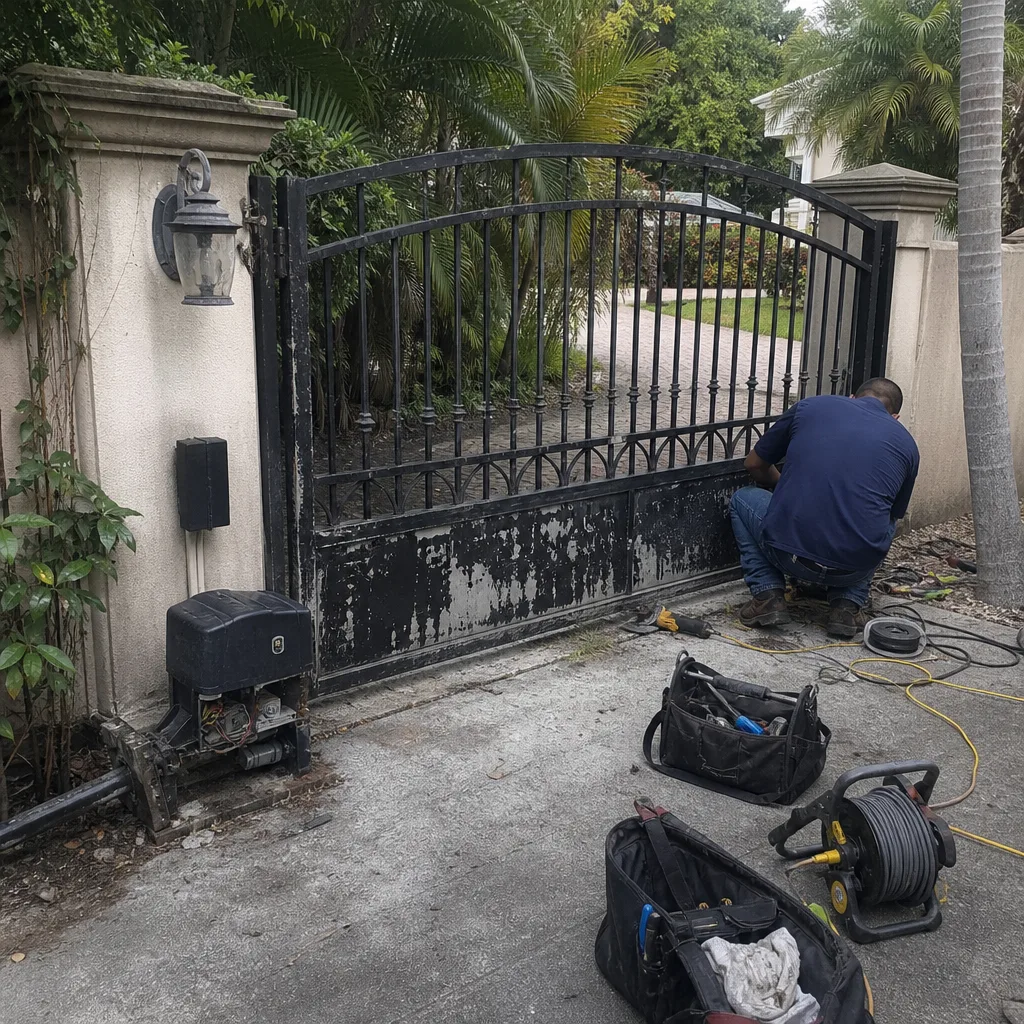 Before
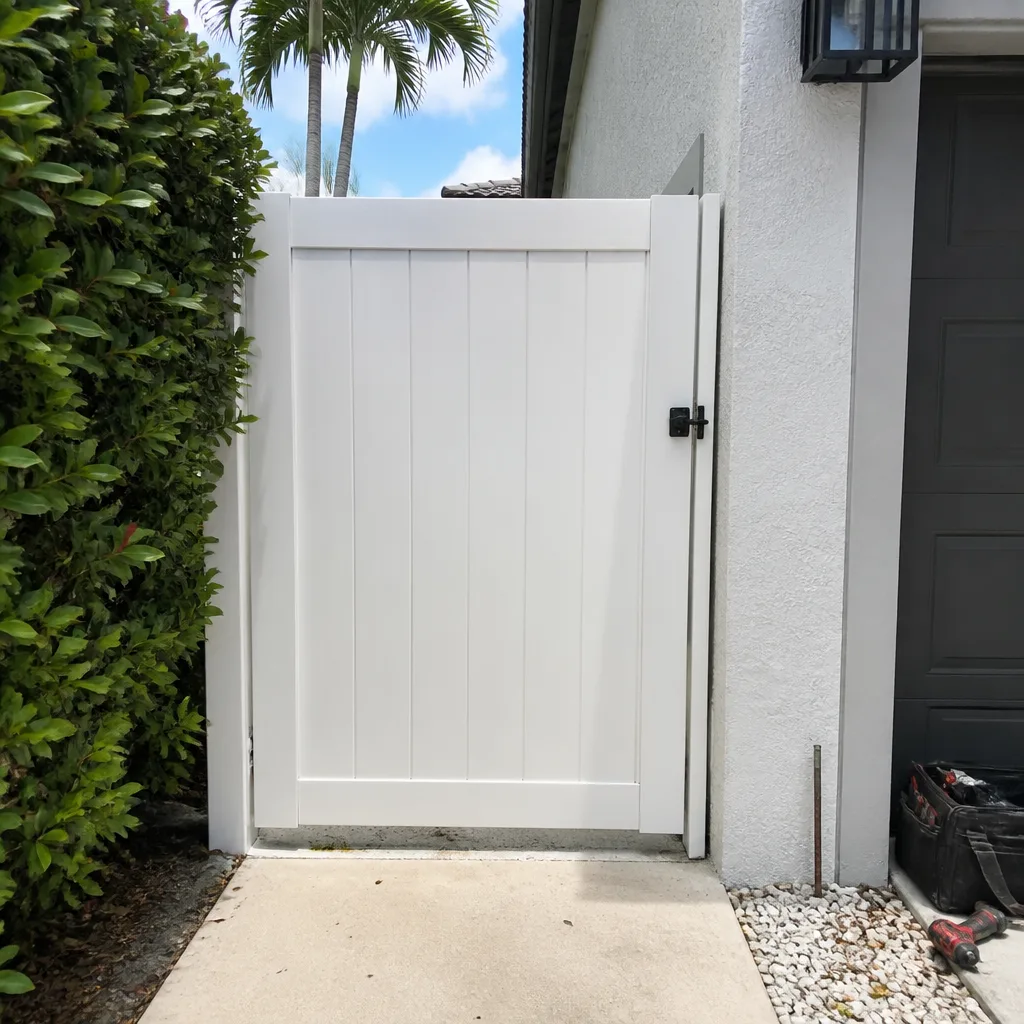 After
After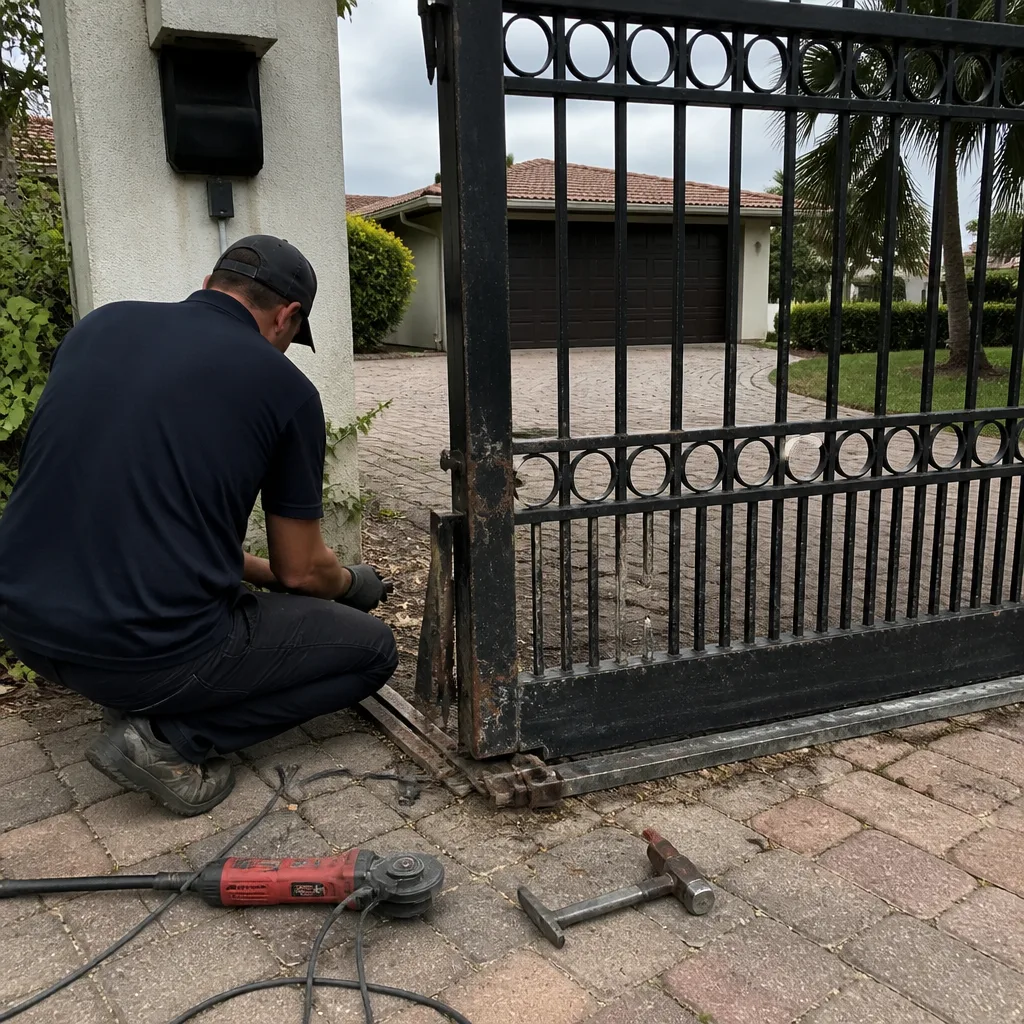 Before
 After
After Before
 After
After